G5 Guides · Victoria · Child safety
Working with Children Checks at a Victorian sports club
At a Victorian club that runs activities for children, anyone whose duties usually involve contact with children needs a Working with Children Check: coaches, team managers and other volunteers. The check is free for volunteers and lasts five years. Since 19 October 2026, applicants complete a free 45-minute child safety course, and the club connects each person through WWC Connect: within 21 days for volunteers and 7 days for paid workers.
From the Social Services Regulator's own pages, read 4 November 2026
This guide sums up the Victorian Government's pages on the Working with Children Check and the Child Safe Standards as they read on 4 November 2026. Both are now run by the Social Services Regulator (SSR). Those pages, the Worker Screening Act 2020 and the Child Wellbeing and Safety Act 2005 are the authority, and your club can ask for more than the law requires.
01Who at a club needs a check
A person needs a Working with Children (WWC) Check when all of these are true:
- they are an adult volunteer, paid worker or self-employed;
- they work in a listed field, which includes clubs and associations, and coaching and tuition;
- their work usually involves direct contact with children (face to face, physical, written, spoken or online);
- that contact is part of their duties; and
- they are not exempt.
Sports clubs are covered when they run activities for or aimed at children, or their members are mainly children. Coaching children is child-related work. Contact that is only incidental, like a plumber at the junior clubrooms, sits outside the rule. And a club can ask anyone for a check, beyond what the law requires.
02Who is exempt
- People under 18.
- Parents volunteering in the activity their own child takes part in.
- Close relatives working only with their relatives' children (kinship carers are not exempt).
- Students aged 18 or 19 volunteering through their own school, VIT-registered teachers, and police officers.
- Visitors from interstate, for limited periods.
There is no general one-off exemption, and none applies to a person with a WWC exclusion.
03Cost, cards and renewals
- Volunteer Clearance: free (renewals and replacement cards too). Reimbursed expenses don't make someone paid.
- Employee Clearance: $139.20 (2026–27), for anyone paid; it covers volunteer work too. A paid coach holds an employee card.
- A Clearance lasts five years. Cards are marked V (volunteer) or E (employee), and there is a digital card in the Service Vic app whose QR code shows it is current.
- Renew online from six months before expiry. A holder who moves clubs adds the new club online; there is no new check.
04What's new since 19 October 2026
- Child safety training: new applicants, people renewing, and volunteers moving to an employee card complete the free WWC Child Safety Training (about 45 minutes, online, self-paced, not pass or fail), then submit the application within 30 days. Current holders do it when they next renew.
- WWC Connect: clubs now connect every worker and volunteer through the Service Victoria WWC Connect service. Its four duties are Check, Connect, Record and Maintain: connect, update or end a volunteer within 21 days, and a paid worker within 7 days. The club gets an email alert if a connected person's Clearance changes. It needs a Service Victoria account and a business profile, and people can be added one at a time or by CSV upload.
05What the club does
- Engage only people who hold a Clearance, have a lodged application being assessed, or are exempt.
- Check each person's status before they start, with Service Victoria's status checker (the card number and surname). Seeing the card alone isn't enough.
- Record each person's check number, card type (V or E) and expiry date.
- Connect them in WWC Connect (21 days for volunteers, 7 for paid workers), and keep it current when they change details or leave.
- Know when each Clearance expires, and keep the details private.
06The Child Safe Standards
Victoria's 11 Child Safe Standards have applied since 1 July 2022, and the SSR took them over in February 2026. A club that provides services or facilities specifically for children, or engages a child as a volunteer or worker, complies with them. In writing, that means:
- a Child Safety and Wellbeing Policy;
- a Code of Conduct for staff and volunteers;
- a child-focused complaints policy;
- current WWC checks for the relevant people, and training to recognise signs of harm;
- risk management, including for online spaces.
Vicsport runs Child Safe Sport resources and a help desk, and Play by the Rules has free safeguarding training for sport.
07How Perch HQ helps
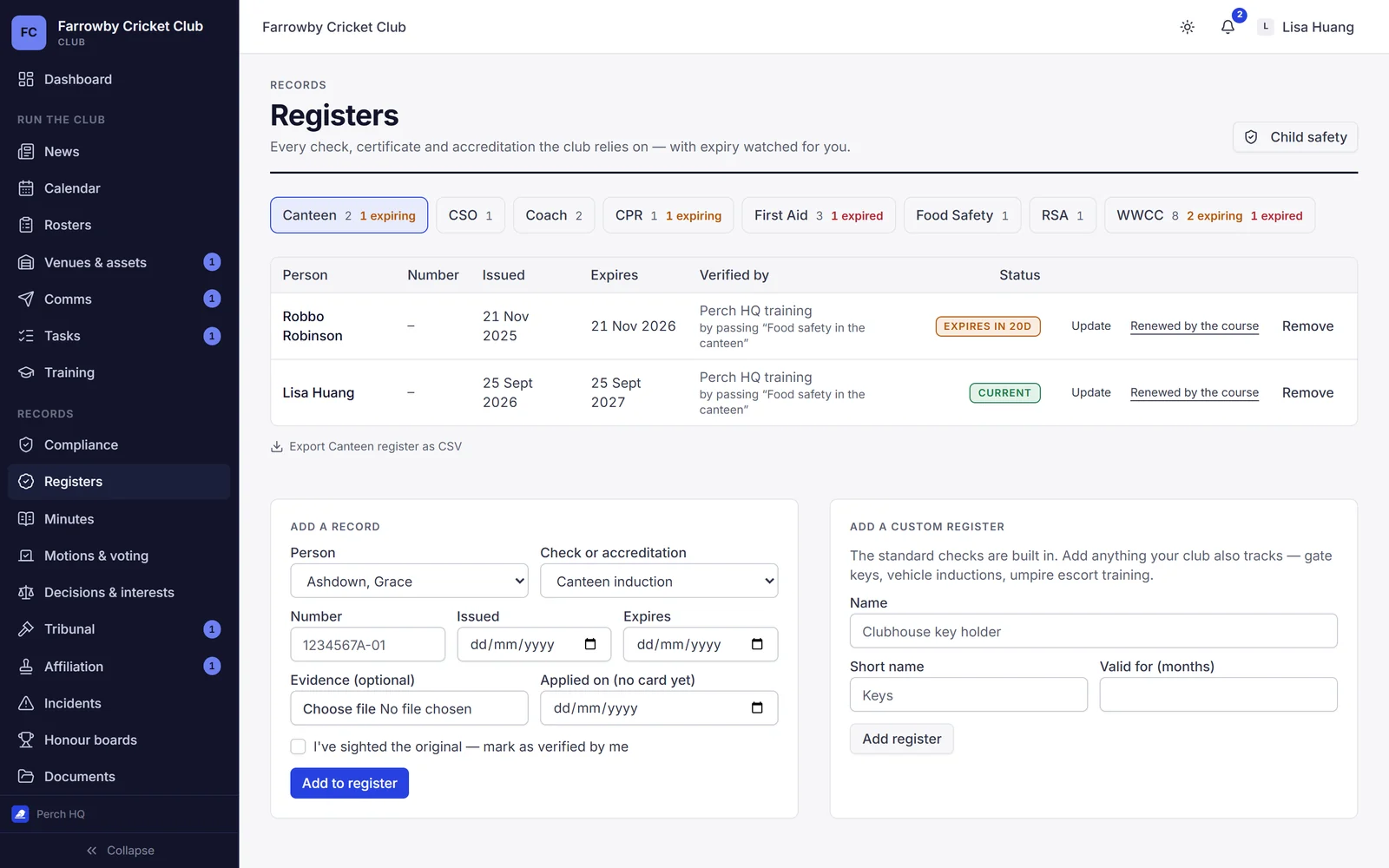
Perch HQ's registers hold the club's working with children checks with their expiry dates, alongside first aid, food safety, RSA and the club's own credentials, and warn before each one runs out. The club's child safety page sits in the same place, and juniors are contacted through a parent or guardian. Connecting people in WWC Connect stays with the club, in Service Victoria. See registers in Perch HQ, or book a demo.
08Sources (read 4 November 2026)
- Victorian Government: Working with Children Check · Do I need a check? · Exemptions · The check explained
- Victorian Government: WWC Connect · Mandatory child safety training · Organisations' legal obligations
- Victorian Government: Child Safe Standards · Complying with the Standards · Who they apply to
09Questions
Does a volunteer coach at a Victorian club need a WWC Check?
Yes, when the club runs activities for children. Coaching children is child-related work. The volunteer check is free and lasts five years. A parent helping only in their own child's activity is exempt.
What is WWC Connect?
Since 19 October 2026, the Service Victoria service clubs use to connect each worker and volunteer to the club: within 21 days for volunteers and 7 days for paid workers. The club is then alerted if a connected person's Clearance changes.
What does a club need for the Child Safe Standards?
A Child Safety and Wellbeing Policy, a Code of Conduct, a child-focused complaints policy, current checks for relevant people, training, and risk management, under Victoria's 11 Standards.